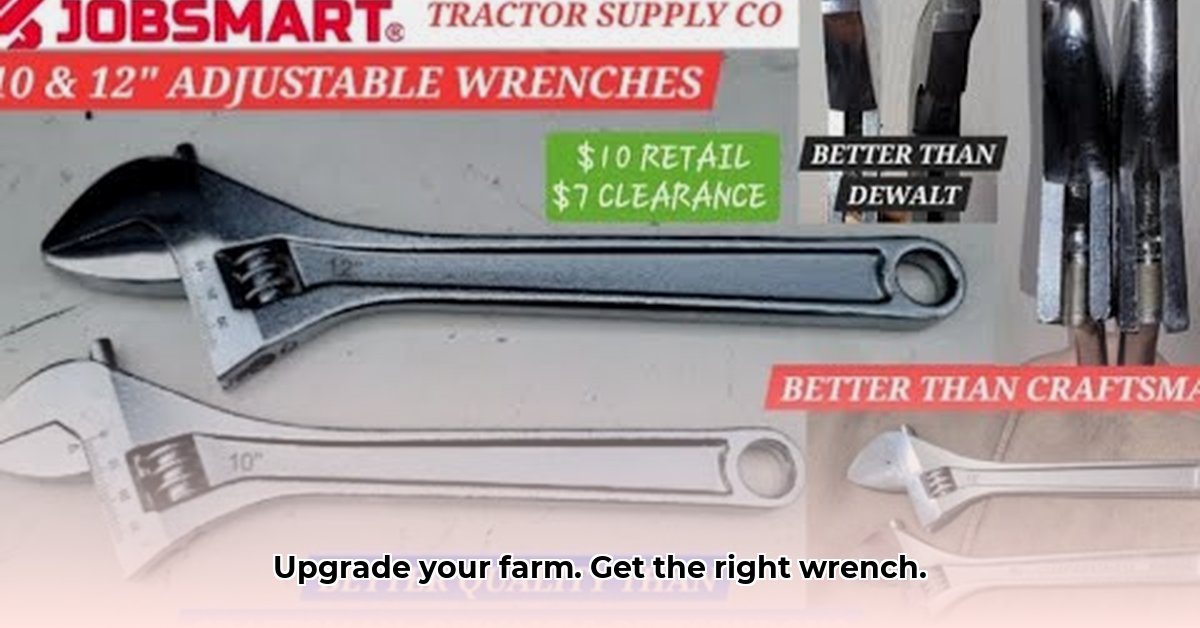
Spanner Wrench Tractor Supply: Your Guide to Finding the Perfect Farm Tool
Choosing the right tools is critical for efficient farm operations. A reliable spanner wrench is essential, and Tractor Supply offers a wide selection. This guide helps you select the best wrench for your needs, maximizing your farm's productivity and minimizing downtime.
Understanding Your Farm's Wrench Needs
Before purchasing, consider the wrench's intended use. Will it handle daily maintenance or heavy-duty repairs? This determines the necessary size, strength, and material. What fastener types (metric or standard) are prevalent on your equipment? A clear understanding upfront prevents future frustrations. Frequency of use also impacts the quality needed: occasional use justifies a less expensive model, while daily use requires a more durable wrench.
Exploring Tractor Supply's Spanner Wrench Selection
Tractor Supply stocks numerous spanner wrenches: open-end, box-end, combination sets, and specialty types. Options vary in size, material, and price. Chrome vanadium steel wrenches offer superior strength and durability but cost more. Less-expensive steel alternatives exist, but their longevity might be reduced. Carefully examine packaging for material details and durability information. Online reviews from other farmers provide valuable insights into a wrench's performance, ease of use, and longevity.
Factors to Consider When Choosing Your Perfect Spanner Wrench
Several key features influence your selection:
Material: Chrome vanadium steel is ideal for its strength and resistance to wear. Less expensive options are available but may have shorter lifespans. Consider the frequency and intensity of use.
Size and Type: Measure nuts and bolts before purchasing to ensure a proper fit. Combination wrenches provide versatility with both open-end and box-end options. Open-end wrenches are quicker for simple adjustments; box-end wrenches offer superior grip, especially for rounded nuts.
Handle Comfort: Prolonged use necessitates an ergonomic handle to minimize hand fatigue. Look for cushioned or contoured handles for a comfortable grip.
Finish: A polished finish resists rust and corrosion, extending the wrench's life. A plain finish may suffice for indoor use, while a polished finish is recommended for outdoor use or humid conditions.
A Simple Guide to Choosing the Right Spanner Wrench
This table summarizes wrench selection based on your tasks:
| Task | Wrench Type | Material Recommendation | Size Range Considerations |
|---|---|---|---|
| General Farm Maintenance | Combination Wrench | Chrome vanadium steel | Varying sizes; match your needs |
| Heavy-duty Equipment Repair | Box-End Wrench (for better grip) | Chrome vanadium steel | Larger sizes |
| Precise Adjustments | Offset Wrench (for tight spaces) | Chrome vanadium steel | Smaller sizes |
| Quick Nut & Bolt Removal | Open-End Wrench | Chrome vanadium or other | Based on your nut and bolt sizes |
Keeping Your Spanner Wrench in Top Shape
Proper care prolongs a wrench's lifespan. Clean it with a wire brush after each use to remove debris. Apply a light lubricant (machine oil) to prevent rust. Store it in a dry location to avoid moisture. Avoid dropping it to prevent damage.
Finding Your Perfect Spanner Wrench at Tractor Supply
By carefully evaluating your needs and exploring Tractor Supply's options, you'll find the ideal spanner wrench. Don't hesitate to seek assistance from store staff; they can advise based on their experience with customers’ requirements. The right tool significantly enhances efficiency and safety.
How to Choose Optimal Precision Irrigation Sensors for Diverse Soil Types
Key Takeaways:
- Precision irrigation, guided by soil moisture sensors, significantly improves water use efficiency and increases crop yields.
- Sensor selection depends on soil type, budget, and technical expertise. Sensors offer varying accuracy, cost, and maintenance needs.
- Successful implementation requires careful consideration of sensor specifications, soil characteristics, and integration with existing farming infrastructure.
- Long-term success hinges on understanding sensor limitations and potential maintenance requirements.
Choosing the right soil moisture sensor is as crucial as selecting the right spanner wrench. This section guides you through the process of choosing optimal precision irrigation sensors for diverse soil types.
Understanding Your Soil
Before sensor selection, understand your soil's characteristics. Sandy soils drain rapidly; clay soils retain water. This impacts sensor accuracy. A sensor suitable for sandy soil may be inaccurate in clay. Consider these factors:
- Soil Texture: (Sandy, silty, clay, or a mix) This affects water movement.
- Soil Salinity: High salinity can interfere with some sensor types.
- Soil Depth: Sensors measure moisture at a specific depth; ensure the reading represents your root zone.
Sensor Technologies: A Comparison
Several soil moisture sensing technologies exist, each with advantages and disadvantages.
| Sensor Technology | Pros | Cons | Suitability |
|---|---|---|---|
| Capacitance | Low cost, relatively easy to use | Accuracy can be affected by soil salinity and texture | Well-suited for lighter soils, less accurate in clay |
| Time Domain Reflectometry (TDR) | High accuracy, less sensitive to salinity | More expensive, complex installation | Best for diverse soil types, even saline conditions |
| Neutron Probe | High accuracy, measures large volume | Uses radioactive material, requires licensing | Best for large-scale fields, specialized use only |
Choosing the Right Sensor: A Step-by-Step Guide
- Assess your soil: Conduct a soil analysis to determine texture, salinity, and typical moisture levels.
- Define your needs: Consider your budget, technical expertise, and field size.
- Compare sensor types: Research capacitance, TDR, and other technologies based on your needs and budget.
- Consider long-term costs: Factor in maintenance, calibration, and replacement costs. Battery life is crucial for remote sensors.
- Test and calibrate: Before full implementation, test sensors in representative areas of your field. Calibration ensures accuracy.
- Integrate with your system: Plan how sensor data will be collected, processed, and used for irrigation decisions. User-friendly interfaces are essential.
Selecting the right sensor is an investment in efficient water management and sustainable farming practices.